Showing posts with label guitar strings. Show all posts

Monday, October 3, 2016

Learning the Fretboard - A Primer On Scales, Arpeggios And Chords

THE IMPORTANCE OF LEARNING SCALES, APREGGIOS AND DIFFERENT CHORD FORMATIONS


Most casual guitarists and many guitarists that play in successful bands do not know music theory on the level that a classical instrumentalist does – with the ability to read staff and the inherent knowledge that reading music brings to the way chords and scales relate to each other.


A WORD ABOUT CHORDS


Over the years, I have broken down guitar chords into three categories for the purposes of speaking about them and relating scales, chord forms and arpeggios to them.

·         The Open Chords - these are the chords that most people start by learning, and are played near the nut using both fretted and open strings

·         Bar Chords, Upper Register – these are bar chords where the root note is located on the fifth string (such as the D at the 5th fret or the C at the 3rd fret)

·         Bar Chords, Lower Register – these are bar chords whose root note is located at the top string (such as the C on the 8th fret, the A on the 5th fret, etc.)

One of the purposes of this article is to get you to see beyond these easy shapes – most chords have three main positions on the neck of the guitar: the open position, the upper register bar chord and the lower register bar chord. B and F chords can only be made as bar chords or by playing tones out of the chords.

By mapping out the locations of the notes of the chord you are working on, as seen below, you can find new ways to play the entire chord or tones out of the chord for richer, fuller songs. This will allow you to give your guitar different sounds as well as a greater ability to create subharmonies, movements and single note runs into what might otherwise simply be 4 bars of a standard C chord.


THE IMPORTANCE OF PATTERNS


Most instruments are not pattern based, but interval based. The keyboard is the classic example of this – a C chord is made of three tones, the One (which is the root note, in this case C), the Three and the Five. The notes for the C chord are below:

One – C note (root)
Three – E note
Five – G note

A minor chord is made by flatting the Three (in this case the ‘E’ note moves to ‘E’ flat).

But on a guitar or other fretted instruments, chords are represented by patterns. If you look below you will see a C Bar chord at the third fret. If you take that chord shape and move it to different frets, it becomes a different chord. For instance, the same shape played at the 5th fret becomes a D chord.

C at 3rd Fret (an upper register chord, where the main root is on the fifth string)


D at 5th Fret – Note that it is the same shape as the C chord above!


(Blank circles on the D indicate root notes)

Now, we want to map out where all the notes are for this chord – in this case, laying out where the triads of the C major chord are will also map the fretboard to find the notes we want.

By looking at these patterns we can figure out different combinations of ways to play chords and chord tones – this may not seem like that big a deal, but finding new tonal combinations to apply to your music can supercharge your creativity, or turn a simple progression into a work of art by playing different inversions and selected notes out of the applicable arpeggio and scale patterns.

This gives you much more room inside the song to find the inherent melody of a progression, and to spice up the progression itself. A great example of this can be seen when we look at the C Triads on the neck of the guitar. A Triad is a three note combination that makes up the chords, but Triads can also be played out of more complex chords.

Here, we see the C Triads – these are also all the notes that make up the C major chord


From the diagram above, we can pick out the familiar patterns of the C chord in question (the Open Chord Shape on the far left at the nut of the fretboard, the 3rd fret shape and the 8th fret shape), but we can also see all the different notes of the C chord across the entire neck of the guitar – remember, after the 12th fret the neck simply repeats itself.


ARPEGGIOS AND CHORDS

Arpeggios are simply the notes of a chord played one at a time, the same as a scale. If you look at a book of guitar arpeggio patterns you will see that all of the patterns will fit within the diagram above. This diagram contains all the notes on the neck that are contained in the C chord, and will allow you to quickly find shapes on the neck that will expand your concept of playing a ‘simple’ C. Mapping out your fret board with these notes will allow you to play chord and tonal variations as well as different inversions (where the root note is not played first) and pick out your own single note arpeggio runs across the entire fretboard of your guitar.

With the power of patterns, once you learn these shapes by heart you will be able to repeat them in any key by moving the starting point of the pattern to a different fret. For instance, just as the D chord above is the same shape as the C chord, just on a different fret, the mapping of the D Chord (D Triads) will show the same patterns as the C Triads, just two frets further up the neck of the guitar.


Notice that you see the exact same shapes as the C Triads, just 2 frets higher – once you learn the Triad and arpeggio shapes for different types of chords, you will know them for all chords of the same type (in this instance, simple major chords), though it will take some practice to master the way you play them!

Practice by learning all the triad shapes possible for the chord you have picked out, and then start practicing those shapes as you practice the normal chord shapes. It won’t take long for you to memorize the triad and tonal shapes that are possible, and then you will be able to see how easily those shapes can be used for any key you desire. This will open up the way you think about chords!


CHORD SUBSTITUTIONS AND EXPANDING YOUR TRIADS

Making small changes in the chords you use, or using chords that can be substituted for the chords in the base melody can greatly expand the freedom you have in playing different combinations of tones and single note runs in your songs. Changing a Major chord to a Major 7th makes a huge expansion in these possibilities, or a Minor chord to a Minor 7th. The seventh adds a fourth tone to the chord, and gives you many more choices for chord alternatives and arpeggios. Check out the full fretboard diagram for the C Major 7th chord quads and you will begin to get an idea of how many more possibilities adding just one tone to a chord will give you!


Not all chord substitutions are so obvious as making a Major a Major 7th, or a Minor a Minor 7th though. Keep in mind that depending on the way the song is constructed, not all substitutions will have the sound you are looking for – experiment with substitutions, but don’t be afraid to abandon an idea that just isn’t working out tonally!

A less obvious chord substitution is a Major chord a third above a Minor 7th root chord. This will make a lot more sense once it is translated into patterns as seen on the diagram below. If you are playing an Am 7th on the 5th fret, a C major chord played on the 3rd fret (or anywhere, for that matter) can be substituted. Not only does this give you a power chord option for a Minor 7th sound, but it also means that you can play any of the C Triads mapped out above when your root chord is an Am 7.

This will allow you to switch between tones and inversions from both the Am7 chord and the C chord, giving you a huge amount of choices in how to play the song.

An easy way to find this pattern is to remember that wherever you play a lower register Minor 7 chord (root note on the (top) 6th string) it will go with the higher register major chord (root note on the 5th string) 2 frets lower. So the 5th fret Am7 goes with the 3rd fret C Major, the 7th fret Bm7 goes with the 5th fret D Major, etc.

Check out the diagram below to see how these chords fit together!


You can see the C Major chord outlined in blue, while the Am7 is outlined in red. When you look at the notes, you will see that the Am7 has just one note extra (the A) from the C Major, which is C – E – G, so the notes for Am7 are A – C – E – G. If you move the Minor 7th chord from the 5th to the 8th fret, it becomes a Cm7 and the companion chord (in blue) becomes the F Major chord with the root on the 5th string at the 6th fret.

All the patterns for triads, arpeggios and tonal combinations that you learn for the Am7 – C pairing will be exactly the same for the Cm7 – F pairing, just 3 frets higher on the neck of the guitar.

Find a good chord book that lists alternative or substitution chords to help you explore this powerful tool, and buy a blank guitar manuscript book to do your own mapping of the fretboard. This will help familiarize you with the fretboard, and is also an excellent memory aid (writing anything down as opposed to looking at pictures or videos triggers different neural pathways in the brain, reinforcing the memories of the material copied down). Oddly enough, according to studies using a keyboard for typing or working with a screen does not give the same benefit as making notes with pen and paper.


SCALES – THE BUILDING BLOCKS OF MELODY

Chords form the basic building block of a song, shaping the song’s rhythm and giving it different tonal characteristics – minor chords for slow sad songs, happy little major chords for fun, bouncy songs, or any combination you can think of. In the example below, it shows one pattern of a C Major scale – with all scales there are 5 -7 patterns you will need to learn. All these pattern are the same scale, but by learning all of the patterns you will know the scale across the entire fretboard of the guitar, and will be able to play the C Major scale (or the same type of scale in any key, for that matter) anywhere on the neck.

All melodies are made of scales one way, or a hybrid of scales that you might stumble across. Just like chords, the scales on a guitar are learned largely by patterns. Like arpeggios, scales are usually played one note at a time, though striking multiple notes can be a great thing!

Any time you hear any single note runs in a song, they are part of a scale or arpeggio.

And, just like chords, once you learn the blues scale or the major scale in one key you will know it in every key – just start the first pattern of the scale on a different fret and it will be in a different key! Once you know these patterns there are also some other tricks that will allow you to easily change the way the scale you are playing interacts with the chords of the rhythm section, giving you different sound palettes as you build your leads or single note runs in the melody structure.

For example, moving the scale pattern below to the 8th fret will change the scale from the C Ionian Major scale to the C Mixolydian (A mode of the Major scale). The easy way to keep track of where the scales can be used is to think about playing them over the two Bar chord shapes, the higher register C bar chord at the 3rd fret and the lower register C bar chord at the 8th fret. Anywhere you play a conventional C bar chord you can start the scale pattern, which will make it a different Mode of the Major scale, in this case Ionian and Mixolydian!


Both of these scales can also be played over Cm and Cm 7 chords as well, but don’t neglect learning the different types of minor scales – they offer wonderful melodic possibilities.

Once a guitarist knows the shape and patterns of all the modes of the major scale, the scale can be played in any key by simply moving the 1st position of the scale to a different starting fret on the guitar. Find a good scale book to learn all the patterns for the different types of scales. For rock and country music, the Pentatonic scale and the Major are two of the most important scales you can learn.

Just like the Major scale, a shortcut to finding where to play the pentatonic scale can be found by rooting the starting position to the standard chord positions – in this case, a C or Cm can be played at the 3rd fret and the 8th fret in bar form.

The pattern below is the Cm Pentatonic scale:


 Note that this pattern of the Cm Pentatonic scale sits right on top of the 8th fret, a prime position for the Cm chord. This pattern can be played on the 5th fret, which makes it a C Major Pentatonic scale, but I have also had good luck playing the scale at the 3rd fret whether the C chord is Major or Minor. As you learn the different scale patterns and how they relate to their root chords you will find that there are multiple ways to play the scale against the chord.

This may seem a little intimidating if you are not already getting into scales and arpeggios, but as you map the fretboard for chord and arpeggio locations, or learn the patterns above you will find yourself making fast progress. If you are already playing scales and arpeggios, looking at the patterns in this way can help you expand your abilities and understanding of the fretboard and come up with great new tonal combinations from simple chords and scales!

James House of Deals, one of the best music stores in Lincolnton offers great deals on instruments, PA Gear, recording equipment, accessories and much more! When you need accessories or guitars in Lincolnton come to James House of Deals!


Wednesday, September 7, 2016

Jay Turser Strat Guitars

Jay Turser Guitars - A Great Alternative!


Jay Turser guitars have been around for a while now, and I have played a number of them. They are a less expensive guitar, but as time has passed they have done a great job at improving their lineup. Although still entry level guitars, they are producing some fine instruments in the less than $200 price range, and some really nice stuff in the $200 - $350 price range, which we will go over in another post. 

Today we are looking at one of their traditional Strat style guitars with a nice see through blue finish. These guitars have had some care put into their manufacture, with a high gloss maple neck, rosewood fingerboards, die cast tuners and jumbo frets.


These guitars pass one of my first tests with any guitar, running your fingers down the sides of the neck and NOT feeling frets poking your fingers as they move down the neck. You would not believe how many higher end guitars (and guitars made in America) do not pass this test.

Jay Turser Electric in Lincolnton NC
Close Up of Jay Turser Strat Style guitar
These guitars have a very nice high gloss maple, rosewood fingerboard and a nice flat radius which make for very fast lead runs, and pretty good die cast tuners.

The pickups are surprisingly good sounding for a rather inexpensive guitar, and they deliver the airy, snappy sounds that made the Stratocaster one of the guitars to use for blues, country and rock!

The high gloss maple neck has an smooth, silky feel!


Die Cast Tuners do a great job of keeping these guitars in tune!

There is also a model of this guitar that has a Double Humbucker in the bridge position, giving it a nice fat distortion sound, but the three single coils in this guitar deliver a fistful of great tones for distortion and clean sounds!

When you are looking for guitars in Lincolnton NC come by James House of Deals to see this guitar and many more! The Jay Turser Strat with see through finish is only $169.99, but there are models starting at just $150 bucks, and we also have many different package options that come with the guitar, strap, tuner, picks and everything else you need to get playing! Come by one of the newest music stores in Lincolnton to see this and all the instruments and accessories we have for you, and remember its never to early to start your Christmas Layaways!


Saturday, August 27, 2016

Harmonicas - What You Need To Know to Play For Fun and Profit!

Harmonicas - What's The Deal!


Harmonicas have a reputation of being one of the easiest instruments to play, and that reputation is deserved. The way most harmonicas are built, each harp that you get will be for a specific key. This means that the notes are laid out for that key, so if you have the right harp, it is almost impossible to play anything out of tune.


This is also why when you are playing a harmonica by itself it has a very musical sound and is easy to get good sounding licks and melodies out of the instrument (with a little bit of practice, of course). 


Harmonicas and Cross Harping

It makes sense - if the song is in C, then you should play a C harp. Unfortunately, that is not always the way it is - fortunately, we are here to help explain it to you! 

Most harmonicas are what they call Diatonic, which means that the harmonica has the keys of the scale for whatever key harp it is - the C harp contains the C Major scale, so the first note on this harp is C, the D Harp contains the notes for the D Major scale, the first hole is a D note. 


But many styles of popular music, including blues, do not sound right when you are the playing the harmonica that is the key of the song. 

Cross Harping, or as some people call it playing in the Second Position takes care of that problem. This means that you will pick the key of the harmonica you are using so that it is a fourth below the key of the song.

If you are playing a song which is in the key of C, a fourth below that will mean that you want a Harmonica in the key of F. Check out the simple table below:

Song Key       Harp Key
A                     D
B                     E
C                      F
D                     G
E                      A
F                      B
G                      C

This C harp, using the above guide, would be used for a lot of songs in the key of G. Some songs will work by playing the harp that matches the song key, but for most popular songs you will want to use the cross harp/Second Position chart above to determine the right key for your harp. Flats stay the same, so a song in B Flat would take an E Flat harp.


If you are just learning, however, you will usually want to start out with a harp in C as most of the harmonica lessons out there are done in C. As you progress and start playing with other people find out what key the songs are in before you jam, and make sure you have the right harmonica to match the song you are playing to!

You can get the Old standby Harmonica at James House of Deals,one of the newest music stores in Lincolnton as well as a large variety of accessories. We also have the biggest selection of used and new guitars in Lincolnton!


Wednesday, August 3, 2016

Are You Getting Your Child a Guitar? What to do to Maximize Their Potential

Get The Right Guitar For Your Kid (Or Anyone Else You Are buying A Guitar For)


It is an old conundrum - you want your child to play the guitar, and it seems like that is what they want also, but until you spend the money there is no way to know whether they will take off on this hobby.

Acoustic Guitar Lincolnton
You can save money and get a better guitar by buying used, like this Epiphone acoustic guitar in Lincolnton

So, the rightful instinct is to not spend much money - the problem with this is, if you get a guitar that is difficult to play or that does not ignite the potential player's imagination you are actually decreasing the chances that the student will stick with it - and this is true of students of all ages!

The first step is to find out what kind of music your child (or friend/spouse/loved one) wants. If they enjoy playing traditional country or folk music, an acoustic guitar is ideal, but if they get into rock or metal, or even some more modern country, an electric guitar may be the best way to go. Remember, there is no 'right' first guitar, despite what some teachers say. 

music store in Lincolnton NC
If your potential player dreams of power chords and singing solos, an electric is the way to go. This is one of many used guitars in Lincolnton that make a great starter pack!
The best first guitar is one that will give the person learning the best chance of making this a lasting hobby - if the potential player hears screaming solos and power chords, an acoustic guitar is like throwing a wet blanket on their dreams - not that they can't succeed, but the chances are less.

However, if that person wants to be a singer songwriter like James Taylor (yes, I am showing my age) a good acoustic guitar is probably the best choice.

BUYING USED GUITARS CAN GET MORE QUALITY FOR YOUR MONEY

One thing that is true across the board is that by buying used guitars you can sometimes get more bang for your buck - a lot more! Whether you are buying used guitars in Lincolnton or anywhere else, make sure the guitar has a warranty, and site along the neck to make sure the neck is nice and straight - we will be doing a post in the near future on exactly what to look for in a used guitar, but you can get a better guitar for your money than buying new!

Go onto Craigslist, or find your local music store in Lincolnton or where ever you live to see what your market has in the way of good used guitars.

Remember, the best guitar you can get for your potential player is the kind that they really want to play - match the guitar up with the music they hear in their heads and maximize the chances of them playing for longer than a month or two!


Tuesday, July 26, 2016

Review - The Denver DD44SCE Acoustic Guitar

A Good Acoustic Electric For Under $200!


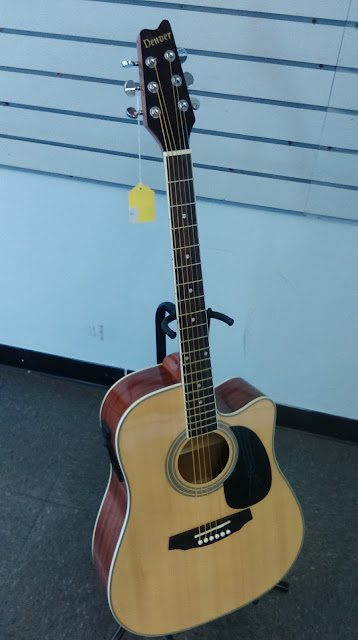
Denver is not a guitar I was familiar with before a few weeks, but I was on the hunt for a good acoustic electric guitar that would sell for less than $200, and I found this guitar in my search. It is made overseas, and has a laminate top, but there is a lot of care taken in quality control and the guitars are set up in Canada - they are distributed by Yorkville, who has a proven track record of quality gear and instruments.

It is a nice looking guitar, with nice, deep wood tones, die cast tuners and an extremely straight neck that has ivory binding and nice, finished, smooth side on the neck. To me, this is a big factor in how much care a company takes with their guitars, and the Denver passes the test nicely.
Guitars in Lincolnton NC

Denver DD44SCE


The DD44SCE has a very straight, very fast playing neck!


The Sound Is The Test

It doesn't matter how nice any acoustic looks, or how much attention to detail the manufacturing process takes - the true test is in how the guitar sounds. This guitar has a bright, aggressive tone. The bottom end could be a bit bigger, but the sound is nice and full, with great projection and rich, full tones. The single note runs sound just as good as the chords.


The DD44SCE also has a basic pickup in it, allowing it to be plugged into an amp or directly into a recording interface for digital recording (although I would use a mic for any recording purposes if possible). The pickup is decent sounding, and the pre-amp does have some EQ control and externally accessible 9v battery.


For as guitar that sells as low as $159.00, this is a great sounding and playing guitar. If you want to get someone a nice starter model for under two hundred bucks, or if you want an inexpensive guitar for a second guitar that you don't have to worry about as much, this Denver DD44ASCE fits the bill nicely.

You can see this guitar and others at one of the best music stores in Lincolnton, James House of Deals & Pawn. They also offer a wide array of the music supplies Lincolnton players need.


Note the neck and body binding on this guitar - the edges of the neck are silky smooth!

Tuesday, July 12, 2016

Floyd Rose and the Four Springs - Guitar Repairs

Floyd Rose Tremolos and New Strings

Floyd Rose tremolos are renowned for being difficult to work with, but they are not as hard to adjust as many people make out. Going up or down a string size can cause problems, though! 

Recently, I changed the string gauge on my Floyd Rose equipped guitar from a 9 gauge D'Addario to a 10 gauge string. Sometimes, simply tightening the tremolo claw set screws will work, but in this case adding a fourth spring was necessary!


As you can see from the picture above and below, once the screws were tightened down they did not have the correct tension - either the Floyd Rose was recessed into the body of the guitar (and would not stay in tune) or it was pulling up out of the guitar (and would not stay in tune).


I decided to add another spring to my guitar - first, loosen the strings to take pressure off of the bridge, then unscrew the two claw screws about three quarters of the way. At this point, I also decided to replace the tremolo claw screws, so I removed one screw at a time, put the new one in and then did the next one.

Replace the screws one at a time after most of the tension has been relieved.


Thread the new screws into same same holes as the old ones - if the holes are loose, insert a toothpick to tighten them!

Next, I realigned the springs so that four could fit in - always make sure the springs are evenly distributed on both the tremolo block and the claw spring!


Next, I re-tightened the set screws until I had a decent amount of tension and then began tuning the guitar. If the tremolo keeps pulling up and the guitar does not stay in tune, you will need to gradually tighten the tremolo claw screws. Think of the springs and the strings like two sides of a teeter totter - both sides must have the exact amount of pressure to keep a Floyd Rose tremolo in tune.

Tighten the screws about 1/2 turn at a time, then re-tune the guitar. Do this until the guitar stays in tune. Occasionally during this process, work the tremolo up and down with the whammy bar.


Once the tremolo is properly adjusted it should be on an even plane with the body of the guitar, or have a very slight elevation (as seen below).


Now the guitar is perfectly in tune! Below you will see why I decided to replace the tremolo claw screws as well - these screws are notorious for being ruined by having the over tighten them, usually because you don't have the exact size of screwdriver necessary.


So if you have a Floyd Rose tremolo, don't be scared to make these adjustments - just go slow, make sure you have the right tools and parts before you begin - in this case, the correct size screwdriver and a pair of needle nose pliers to move the springs to the proper places.

Of course, if you need help you can always come by James House of Deals & Pawn - we offer a wide range of guitar adjustments and guitar repair Lincolnton players need - and string changes and set ups are on sale right now! Just swing by the music store Lincolnton players now have available to them for all the music gear Lincolnton needs.


Saturday, July 9, 2016

Making Sure Your Guitar Stays in Tune!

MAKING SURE YOUR GUITAR IS STAYING IN TUNE!


It is the time of year for playing guitar - the long summer days lend themselves to creative pursuits, and playing the guitar has been a long favorite of folks, whether it is on the porch of an evening, jamming in a band or strumming a few chords during TV commercials!

There is little more aggravating than realizing that your guitar is not staying in tune though, and there are several things that could be going on which could cause chronic problems with your guitar staying in tune.


Guitar Strings Lincolnton

The two most obvious reasons are either that the strings are old (or were defective right out of the box) or that they were improperly installed. This is surprisingly easy to do, but with a little care you can make sure your strings are installed like a pro!

Put The Strings On Right To Avoid Bad Tuning!


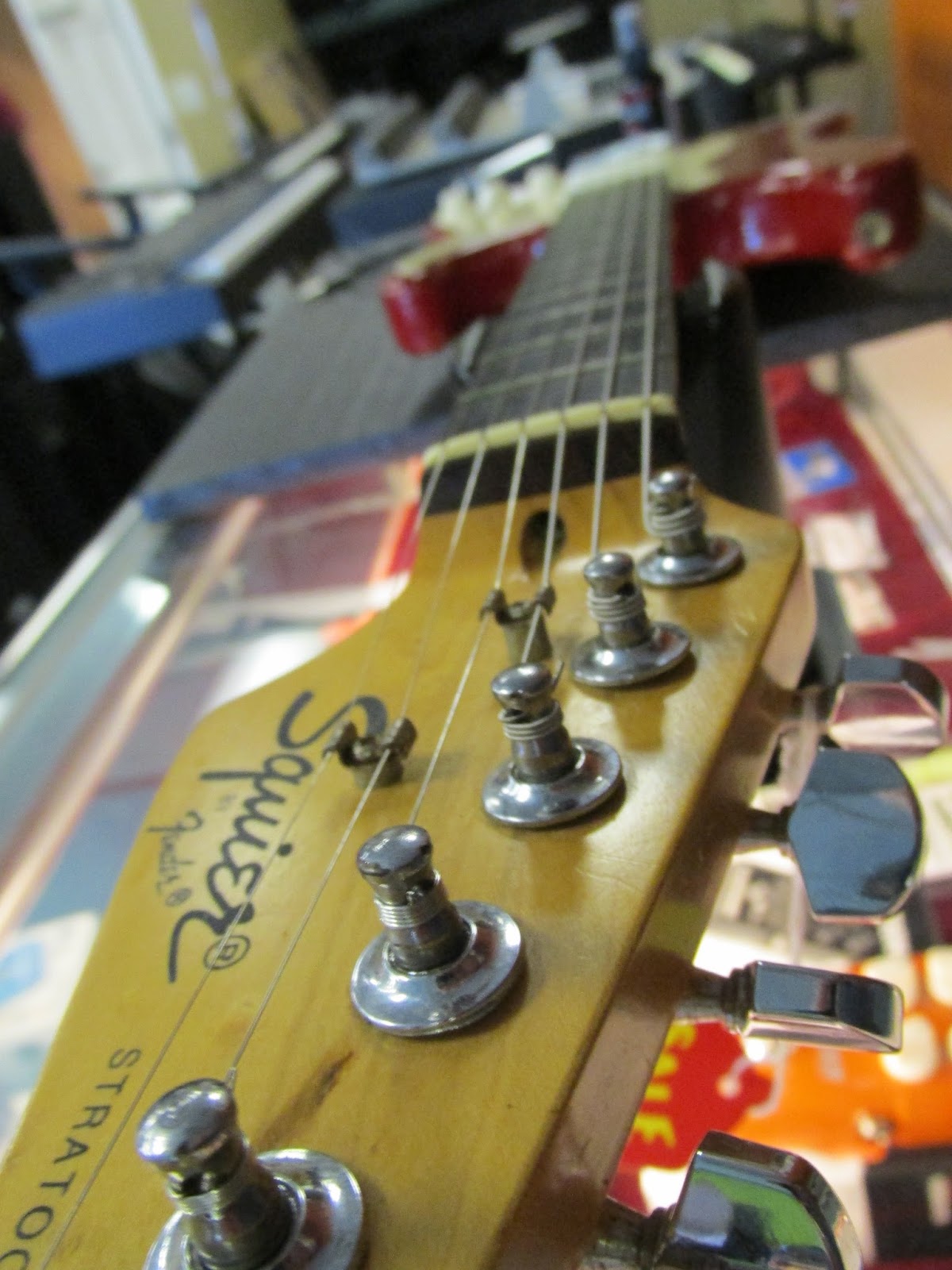
When installing your strings, make sure they are wrapped around the tuning peg enough times! As you see in the picture below, unwrapped strings should wrap around the post at least 4-6 times, while the wrapped strings can hold their grip with 3-4 times around the post.


If the strings do not wrap around the post enough times they will gradually pull loose when you tune and play the guitar - this is especially true of the plain steel (unwrapped) strings. Paying attention to this one simple thing will help keep your guitar in tune more than any other trick we can teach you!


What If It Isn't The Strings?


Sometimes it is not the strings that make your guitar out of tune - have you ever tuned your strings perfectly but the chords you make just don't sound right, especially as you move up the neck?

This type of problem is usually caused by intonation or neck adjustment issues, and the guitar will have to be adjusted on a more in depth basis. We will post more articles on doing this yourself in the coming weeks and months, but if your guitar needs adjustments or you need guitar repairs in Lincolnton come to James House of Deals, a music store Lincolnton players can rely on to supply great services and pricing on a wide array of guitar strings, tuners, and lots of other musical gear!

Music Store Lincolnton NC


James House of Deals is currently featuring the specials below to keep your axe in its best shape!

Restringing Acoustic or Electric - $12.00

Strings are included!

Set-up of Your Guitar - $25.00

Set up includes neck adjustment, cleaning, fret board treatment and more and strings are included!

Guitar Strings Installed . . . $12.00
Includes Strings
Guitar Set-Ups . . . $25.00
Includes Neck Adjustment, Intonation, Strings & More!

Guitar Strings Installed . . . $12.00
Includes Strings
Guitar Set-Ups . . . $25.00
Includes Neck Adjustment, Intonation, Strings & More!